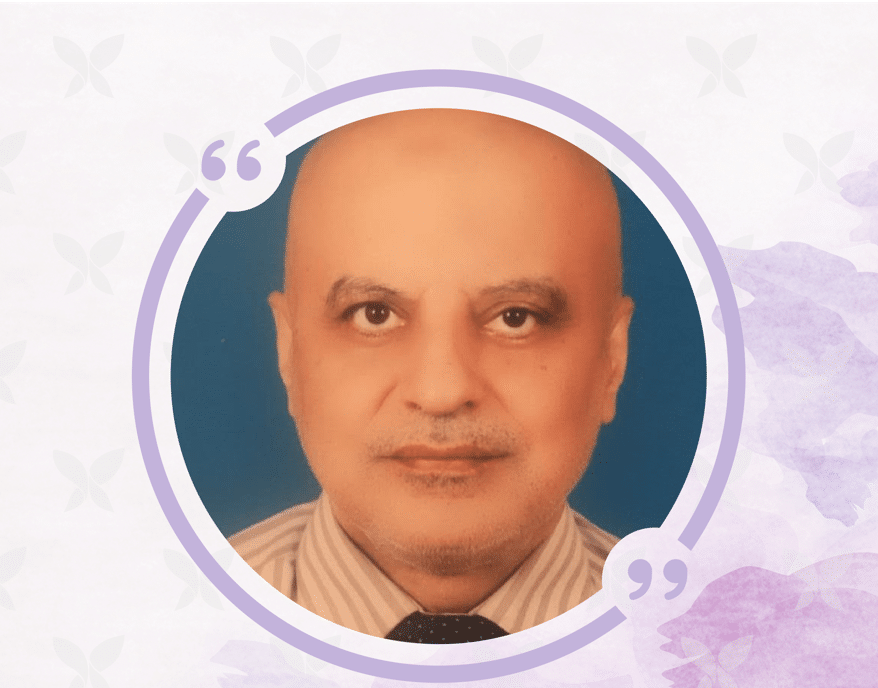
Mohammed Shabaan: with patience and faith, I’m living with cancer

Mohammed Shabaan is a 55-year-old man who has always been on a healthy diet and followed a fitness regimen, describing it as a way of living. He has a small farm at home where he grows various kinds of fruits and vegetables. He has always been interested in the wide range of benefits these organic corps provide. For example, the Moringa tree is one of the crops he is harvesting on his farm; it reduces blood sugar and has anti-inflammatory and antioxidant effects.

March 2017 was the time Mohammed described as the time he “dropped down.” this initially started as mild constipation, which he attributed to ingestion of pomegranate; however, the constipation was persistent and remained for ten days, and he decided to seek medical attention. He was given laxatives, but his condition did not improve. Then, he started having a sudden onset of vomiting, which was severe as he felt tired and energy drained. The accumulation of all these symptoms led to him not walking, so he called the ambulance.

Mohammed had multiple tests done; He had both CT and PT scans done, which concluded the potential of having Stage 3 Colon Cancer. He had never imagined this diagnosis as he thought these symptoms would be due to a fleeting cause, which can be resolved quickly and last a few days. As he requested, the news was brought to him in a friendly manner in the absence of his parents. Once Mohammed was informed about his diagnosis, the only thing constantly on his mind was the surgery and the complications that followed the procedure. He was ready to confront the struggles which are brought to him by his fate, which, in this case, had brought him cancer. “Cancer? I don’t care about it,” he said as I asked him about what he felt when the physician told him about his condition, prognosis, and management. Mohammed proved that each person could beat disease by learning how to cope with it.

He was constantly thinking about the complications he could avoid; one of these dreaded complications was temporarily placing a colostomy bag until a reconnection between the colon and the rectum healed. He was anxious and worried about the perspective of his friends and family regarding the idea of having an external bag for feces. He thought that this might ruin his image and reputation in front of them.

This discussion continued for a long time until the physician decided that an urgent surgical intervention should occur as the patient had a bowel obstruction, leading to fatal sequelae. The physician tried to insert a tube to remove all the poisons from Mohammed’s abdomen, but they could not. However, another surgeon arrived in Qatar that day and was called to the Operation Room (OR). This surgeon was determined not to leave the OR until he inserted the tube. Mohammed described him as one who has confidence and trust in god’s will. He could insert the box without any complications or danger to Mohammed. “These were all complications that only God knows of,” said Mohammed, believing that he was in a sophisticated situation leading to a path of his well-being and survival.

The removal of the poisons from his body took one and a half hours. He felt better and more relieved afterward. He had surgical excision of 80% of his colon and adjacent lymph nodes. This journey was described as crossing an ocean with strong tides against him, but he passed safely; however, as this ended, another battle was coming up against him: Chemotherapy. The side effects of the chemotherapy were very severe; he experienced diarrhea and weight loss – He had lost 20 kgs. Nevertheless, he was relieved that he reached a state of almost winning the battle against cancer; the side effects did not matter as he had passed two storms set by cancer, the surgery, and the chemotherapy. He knew that he had reached the winning line with himself leading.

He found his family and friends very supportive and understanding during that period. Although there was a negative stigma of having cancer, he noticed that he and his family changed and became more accepting; they grew to accept that cancer, like any other disease, can be treated and should not be considered as the closure of one’s life.

Eight months after the surgery, Mohammed developed an abdominal hernia; he sought treatment and gained more strength to face this new complication. He sought both physical and mental therapy. He “Never lost hope” and was able to live through this dreadful journey of fighting cancer and its following complications.


Cancer was an “uninvited guest,” but you must offer hospitality and welcome like any other guest. Thus, one should find a support group and habits that bring joy and happiness to embrace this disease rather than allow it to drain them. It would help if you did not let this monstrous disease take over your lives and consider it as something that is only passing by but is offering you a grain of strength and enlightenment, making you a stronger warrior. Cancer is the beginning of a new life, not the end.

The “Step of Hope” initiative was launched in collaboration with the Qatar Cancer Society and the National Center for Cancer Care and Research. This initiative aims to support individuals living with cancer and emphasize that cancer can be cured. Patients can practice their daily lives and highlight the importance of psychological and community support for this group to make the disease period and beyond easier and the importance of a healthy lifestyle of exercise and healthy food to prevent diseases, especially cancer.

During this initiative, I walked about 555 km on foot in the first phase and then completed the tour to cover 2022 km as a later goal. And we have chosen 2022 for the 2022 World Cup in Qatar, where I seek to walk about 25 km per day at a rate of five hours.

I want to emphasize that this initiative is an opportunity to strengthen the role of physical activity in the prevention of diseases, especially cancer, in line with the State Vision 2030 to improve human health, in addition to emphasizing the close relationship between cancer and mental status that may facilitate or prevent treatment.

 In conclusion, I would like to express my thanks and gratitude to the Qatar Cancer Society as it has adopted the ” step of hope” its kind in the world, and all its efforts and support; this initiative is considered the first of its kind in the world, and I want to thank the Qatar cancer society for their hard effort and continuous support for me and success of this event.
Read more...

Suma, Having cancer changed my outlook on life.

My name is Suma; I’m a Nurse Specialist. I always cared for patients with Lung cancer who are primarily diagnosed in advanced stages and hence need palliative care, thinking that I can ease their pains and sorrows – I can be their shield against cancer, against a villain who I have never expected to face myself, but I was wrong; July 2016 was the time for me to be bold and fight against it, and at that time, I found my patients to be my strong, protective shield throughout my journey. I had persistent fatigue, so I decided to see a physician; then, I had blood tests and a mammogram, which showed that I might lump in my breast, so a biopsy was obtained. This biopsy conveyed a diagnosis that I had never imagined. It translated my fatigue into something beyond my imagination. I was told that I have Stage 1 Breast Cancer.

Denial and rejection were all that I was feeling initially; I was not able to grasp the fact that I had cancer. I went home that day with a heavy heart, with serious steps, carrying a worrying diagnosis, which should have been the end of my story. I went home where I was sure I would feel secure; I went home to see my children and to listen to their joyful stories; I went home to be embraced by my family as my heart was filled with worry, and they’re the only ones who can enlighten it. Then came the question: should I inform my family yet? Will they be able to grasp it? I believed in them and knew they would support me with every step I took.

I informed my husband; he broke into tears. He cared for me a lot and was upset about my well-being. As time passed, he accepted it, and so did I. We both were ready to fight it together. He was always strong and by my side when I needed him. He comforted me and was there for me throughout the treatment. I had a one-year treatment phase, which included surgical treatment followed by chemotherapy, radiation therapy, and targeted therapy. I was tired and physically drained but I knew I was strong enough to handle it. I did things I enjoyed during my treatment cycle; for example, I’m a workaholic; thus, working although I’m sick took away all the sickness which I was experiencing as I felt happy doing my assigned duties. I showed this physically-draining disease that I’d appreciate life more as much as it drains me. I decided not to take sick leave; I went to work and helped my patients as I now know what they go through when they are sick. Cancer has enlightened my perspective regarding the disease and made me a better carer for my patients. Was I losing hair? Being fatigued? Having mood swings? This all vanished when I realized I was strong enough to win this battle. I gained strength through my family’s support, my patient’s well-being, and acceptance of my illness. In addition, my spiritual habits and strong relationship with god made me stronger and wiser, as I started to look at this condition as any other condition that will pass, making me mentally and physically stronger.

Cancer throws a person into a deep end, thinking that they entered a tunnel with no opening on the other side, but this is not the case; one should believe that they have the tools to create a space for themselves, leading to their well-being and acceptance. For that to happen, one must establish a positive attitude, supportive group, hope, and faith. Do things that make you happy, support others, and give yourself time to heal. Let it be; you can fight it.


Read more...

Sami Fattouh: I am proud of myself and thanks to QCS for the support.

My name is Sami Fattouh. I am eight years old, Syrian, live in Canada, and go to Fairview public school. I have fond memories of Qatar, the country I have lived in and one of the most beloved countries in my heart.

I speak Arabic and English. My parents enrolled me in a different school to learn Arabic after they felt that I started to forget it little by little because of living in Canada. I love to play in public parks and ride bikes. My dream is to become an adventurer, a paleontologist, and an astronaut in the future.

When I was three years old, I started to feel pain in my leg, but my parents did not want to worry me, so they told me that I had to go to the doctor to know the reason. when I was six, my parents told me, “We did not want you to be anxious when you were young; you had cancer since you were three.” At seven, my parents informed me more about Cancer and how it varies. I learned more when I started school. The treatment lasted for 36 months at the hospital. I completed the treatment, checkups, and medication at home. I still remember when my friends visited me and bought me presents. My favorite gift was Air Wheels Cars.

Cancer has many types. Any of them may attack body organs… You have to be punctual and take the medication in a strict amount and promptly. There was a playroom in the basement where I frequently played with my brother. Sometimes, I would stroll down the street with friends in Doha. But sometimes, the doctors recommended stopping visitors from seeing me. Therefore, in cooperation with Qatar Cancer Society (QCS), several volunteers would come to my room to make happy faces across the glass in the hospital and give me gifts so I could smile and even laugh. The doctors were kind and friendly.

My grandparents and aunts were paying visits to me constantly, bringing gifts and favorite foods. I decorated my room during Ramadan with crescents, stars, and lanterns. My family accompanied me every single moment of my journey. We always engaged in different activities, such as watching TV or playing cards. The intravenous treatment was painful; I was sometimes intense and weak at others. my uncle Mustafa and Khaled had their hair cut and said, “Come on, Sami, you have to have your hair cut.” I didn’t know that hair loss was a side effect of chemo. I guessed they encouraged me to cut my hair because it was a competition.

I have been feeling pain sometimes, but not always. Once, my cheeks were ripped out of the inside from the chemo, and it was painful, so I had to go to the hospital. It turns out I had cracks in my digestive system. It took a month to treat these cracks. I was no longer able to eat. I lost weight quickly. There were dry spots on my cheek inside, and I was crying from the pain, but soon I was playing and stopped crying. I liked eating the pasta the hospital served, and my mother started cooking it for me at home. I am used to eating it, and to this day, I call it ‘the hospital pasta.’ I also used to ask my mother to call my grandmother to ask her to make me kibbeh and mahshi.

I was so proud of myself when my parents called me Victor because I had beaten Cancer; Cancer significantly prevented me from hanging out with friends, going to preschool, and riding horses and bikes. It even stopped me from strolling down through the park. However, I used to walk in the hospital garden and play in the games room. I used to ask my aunt to take me to the games room during closing hours, and I used to go back to my room sadly to compensate my aunt, who gave me an iPad, to play games and watch YouTube together. I was accustomed to playing with toy trucks and characters, and I liked to run outside with my brother Iyad, but unfortunately, I could not run fast.

I was bored in the early days of my stay in the hospital, but I stopped being bored with the help of QCS and my family. My friends used to come to visit me and bring toys. I put those toys aside to be a souvenir for these difficult days. My brother and I frequently played with them. I have donated some of the toys to those in need. QCS used to give many gifts, and some of their members warmed my heart, especially when they dressed as clowns and cartoon characters.

QCS has provided me with much support and encouragement by inviting my parents and me to the events they organize. When I finished the treatment period, I could do everything. I will return to my usual life as before. I will sleep, as usual, go shopping, and go to classes.


The mother tells her memories of this  journey, saying :

“Stories of hope and people’s life experiences are the most important things that patients and their families seek. What matters most is that they are the hope and motivation to give more hope. Patients and families seek similar experiences and success stories that inspire patience and hope.

When the doctor told us that Sami had leukemia, it was a huge shock. Nevertheless, the involvement of our family and friends around us was a helpful factor in relieving the situation. Besides, credible doctors, thoughtful responses, and direct care from health professionals in Qatar have played a significant role in introducing the disease to us and calming us. We still remember our first stays at the hospital as the most challenging phase of our lives.

سWe had thought it was the end. Cancer is a diverse disease that affects people and ends their lives. We were trying to learn more about this disease and the recovery rate. We’ve been trying to hear any person’s experience that may lift our spirits and give us hope. I was praying for God to save my son and remove this ordeal. We quickly became ambassadors who spread hope among patients.

Sami responded to the treatment and medication processes despite the difficulties and complications. As a result of the lack of immunity, he sometimes developed some infections, and treatment was stopped. He has been infected with hepatitis, fluid retention, and heart inflammation. The cracks in his cheek, which Sami talks about with a smile now, were one of his most challenging experiences. These ulcers continued for 30 days, and he could not eat or drink, so the condition worsened. His digestive system completely deteriorated after chemotherapy until the doctors temporarily stopped treatment. Eventually, he recovered.

After Sami was discharged from the hospital, we decided to play a role in alleviating people’s suffering by paying short visits to other patients, telling them Sami’s success story, and providing them with advice. Through the effectiveness of QCS, I can inspire you with our journey. While describing his story, I am thrilled with Sami, a hero who achieved his voice faster and reached a more significant segment of society.

We were waiting patiently for Sami’s recovery day, and I took photos and videos to document the moments in his journey. Our feelings were a mixture of joy, and we ended this phase of his life with some concern about a possible relapse, God forbid. Still, this obsession haunts me even now, but it will gradually ease with time. However, I relate any minor illness of Sami to the possibility of his disease returning.

In conclusion, I sincerely thank QCS, who are still by our side. They have supported us financially and emotionally. Their programs and targeted activities mean a lot to families and patients.


Read more...

Faiza Al Kaabi : I am lucky with my family.. now I see life more clearly.

 I felt it twice, and I kept feeling it until I realized I needed to see a doctor about it. At the doctor’s office, I was told it was a muscle cramp; I was given painkillers and sent on my way. However, the pain came back when I ran out of painkillers on vacation with my sister; therefore, I made an appointment at a clinic in Istanbul.

 When Faiza Al Kaabi – The owner of the story – went to her appointment, she described her pain to the doctor, who ordered some tests, and when the test results finally came back, her sister found out before her, and she could see in her face” Bad news. “

Faiza said, “I had lymphoma around the lungs, and the cancer had spread to my underarm and abdomen.

I was shocked–I couldn’t believe it. I had cancer. I used to participate in events to support cancer patients, and now they tell me I am a cancer patient. How did this happen? I had no bad habits that could cause cancer: I was active, constantly moving around. Why did this happen? Was it a test from Allah? Was it an affliction, and if so, for how long? Was it a punishment–what am I being punished for? What is my future going to be like? Will even I have a lot, to begin with? I had too many questions running around, colliding in my head. I was torn; one part of me thought it made sense that I had cancer. The pain was there (I could feel it); the test results were there, confirming the diagnosis. And yet the other part of me couldn’t make sense of it, and that part screamed, “This is me we are talking about! How can I have cancer!” But I did. I had cancer.

My head was a tangled web of thoughts, and the world was moving too fast. I needed to decide if I wanted treatment, and if so, I needed to start treatment immediately. I needed to decide where will I get the treatment. Will I return to Doha, get treated there, or stay in a foreign country? I needed to make too many decisions, and I needed to make them quickly. I couldn’t decide since I was still confused and in disbelief. Eventually, I pulled myself together and decided to get my treatment abroad with the same doctor who diagnosed me.

As my first chemo session approached, more and more people called me to tell me that I was strong and would get through it, and after a while, I started to believe it. I began to accept that I had cancer. By that point, some of the initial shock dissipated, but not all of it.

Everything changed a few days before Eid Al-Adha when I started chemo. The chemo shocked my body: I was constantly tired and vomiting, I was irritable and anxious, and I couldn’t eat without getting nauseous. I reached a point where I wished my mother would not visit me so that she would not bring me food that would make me sick. It felt as if I became a new person that didn’t know what she wanted or how to express it; I felt like I was in the middle of a storm, alone with a stranger that is supposed to be me, and my task was to get to know the stranger. I was in such agony that I prayed for patience to bear all this pain and the trials to come the day before Eid.

The first day of Eid came, and Faiza felt even worse. Her family looked as if they had been at a funeral. Everyone had a frown on their face. They couldn’t smile or be happy, and they couldn’t even wish each other a happy Eid. Eid seemed like a burden on her family, reminding them that while the rest of the world was enjoying this “happy” day, something was eating her from the inside out.

A week after my first chemo session was my birthday. The chemo was wreaking havoc inside my body, and I felt every little change the chemo was inducing. I felt the pain of every dying cancer cell and was exhausted. The pain was too much. I reached a point where I started to question why I was doing this. Why am I putting myself through this torture? Why am I bearing all this agony?

My reason became apparent when I saw the unshed tears in my family’s eyes and how hard they tried to make the treatment more accessible and make me happy. On my birthday, my sisters rented a yacht. On the yacht, they showed me how much they loved me; they prepared a birthday dinner with cakes and gifts and even wrote my name with a laser on Bosphorus Bridge. I was over the moon. I forgot about the pain and was too happy to think about it or feel it. In that blissful moment, I thought, “If I die after today, I will be content.” That day gave me an intense dose of happiness that kept me going.

My family treated me with love. They showed me how much they loved me through the little things. The smell of detergent bothered me, so they told me to leave the room whenever they wanted to use it. I saw how worried they were about me. My sister couldn’t sleep well and would wake me up and ask me if I was alright. My mother couldn’t eat because I couldn’t eat. She would cook me food daily, even though it was hard for her to get up and stand due to a leg problem. It soon became apparent that I feared leaving my family behind rather than fearing death.

When it was time for one of my sisters to return to Doha for her kids, I could sense her heart’s dilemma. She left a part of her heart with me, while the other part belonged to her children. We were all having dinner one last time before my sister went back to Doha when I broke the news to them. “I haven’t had enough of you all yet,” I said. “There are so many more experiences that I want to have with you. I want to grow old with you. I will bear it all for you; I will endure the pain, bear the nausea and the fatigue. I will come back for you, sister.” Everyone broke down in tears. I realized I was one of the lucky ones. I had so many people that loved me and cared for me. The people who weren’t physically with me called me every day without getting bored to check up on me.

It took me a while, but I accepted my illness. I was in a situation I couldn’t get out of. What was I going to do about it? My doctor told me that my chances of survival were high. Nonetheless, some people don’t get better and die. He said, “It’s still a disease, treat it like you would anything else, and leave the medicine for me and focus on yourself.” And that I did.

After my third chemo, I learned to live with my cancer. I had a chair in the bathroom for when I got dizzy and bags for when I needed to vomit. I knew that lemon made me nauseous, so I steered clear of it. I had one of my sisters sneak ice cream into my hospital room behind the nurse’s back since I wasn’t allowed to have any. I had my favorite books sent over from Doha to read them whenever I felt like it. I let my body adjust to the new reality of cancer and chemotherapy.

Even with my family’s unwavering support, I had moments of weakness. I was left alone in an isolated room for six chemo sessions, with no sound except for machines beeping here and there. I was starved of human interaction. I missed being with people and socializing with them. The loneliness of the treatment room, combined with the inconsistent illness that the chemo brought on, pushed me to a point where I couldn’t make the most straightforward decisions, so I surrendered my autonomy to those I trusted most, my family. During my moments of weakness, I felt insufferable pain that made me want to quit, but my sister wouldn’t let me. She would ask me to bear it for her if not for myself, which made me angry. I didn’t want to take this torture for anyone. My sister would leave me to my thoughts after my outbursts. I would think about what she said and remember why I started treatment in the first place: I started it for them.

Six chemotherapy sessions in total. It sounded like a lot and like the sixth session was so far away, out of my reach. Regardless, I did it: I finished the first course of chemotherapy, and now, it was time for the doctor to check and see if chemotherapy had any effect on my cancer.

I had no expectations for the test results. I was neither hopeful nor was I pessimistic. I didn’t want to have hope to get disappointed, and I didn’t want to think negatively. Whatever the test results were, I would have accepted them. I was in a place of tranquility. If the doctor told me the treatment didn’t work and there was nothing else he could do, I would be upset, but I accepted death. I didn’t take death as the end. Instead, I took it from a religious perspective. “If you yearn to meet Allah, Allah will also yearn to meet you.” That phrase gave me comfort and courage to face my death. My family, of course, wouldn’t hear any of this, but it was a possibility that we all needed to acknowledge. If the doctor told me I had a little while left, I would go back to Doha and gather all my loved ones to see them one last time before I departed this universe and entered another. If he told me my end was near, I would stay in this country until my time was up.

“Fayzah, I have some news for you,” said the doctor.

“What?” I asked.

“Good news,” the doctor answered. I expected him to say that my body was responding well to treatment or other things doctors say to their patients to motivate them. What he said next left me speechless and baffled.

“The test results are out: they show a healthy body.”

Everyone calls me a hero for beating cancer, but I do not feel like one. I had moments of weakness, for no one is strong regarding illness. Sometimes we can’t sleep due to a toothache. Imagine what it would be like to feel the ache of cancer and chemo. It has been a year since I got cancer. I don’t know if it will ever come back or when. Maybe I got cancer to change how I see things, to tell me that I needed to live my life better. However, I know I am stronger now, thanks to cancer.

My life was a dirty lens before cancer–blurry and unclear–and cancer helped me clean it and see the world. I stopped letting the small things bother me, for life is more significant than whatever little thing is trying to upset you. Cancer taught me to choose myself and those who love me over work because I am easily replaceable at work, whereas I am irreplaceable for my loved ones. I realized that losing my hair is nothing compared to losing my soul and that I should do whatever it takes to preserve it, for a single hair doesn’t determine my happiness, and my soul is what matters.

I am grateful that I belong to a community where strangers will reach out and ask about you, and other strangers will start a charity project in your name just because they heard you were sick. Nonetheless, I hope that one day people will stop treating cancer as if it were a disgrace: we, cancer patients and survivors, did not choose or ask for it.

I can say to those who were just diagnosed, “I prevailed, and so can you.” There isn’t a single disease on earth without a cure. Humans haven’t discovered the cures for “incurable” diseases. Listen to your doctor and only your doctor for medical advice, and focus on yourself.

I’m glad I put up with the treatment a year later because many things are worth the pain and living for. I’m so happy that I got cancer and went through this experience. Given the choice, I would not return to the way things were because I now see things.

I wouldn’t wish that someone would go through what I went through, but if someone has cancer, take it with courage. We can do this together. We are part of a supportive community that wants to be there for everyone. I am sharing my story as my way to be there for you.

Read more...

Rana Shahryar : My experience left an indelible mark, and made me more positive

On June 14th, 2013, I felt a tightness followed by a pain in my chest. It wasn’t sore like I had after a futile effort fighting off a bench press sitting on my sternum. It felt like some uncomfortable imp pushing against my heart to leave my chest, and my heart responded by beating back in a morbidly familiar way. I went to the hospital for an EKG, and years of learning vectors in Physics made me an expert in reading, or at least I remember saying as much. They then put an IV cannula on my hand, the first of many that year, and injected contrast for the upcoming CT scan.

Rana Shahryar talked about his experience with cancer, saying: “I was eventually diagnosed with lymphoma. There was a medical who was doing a rotation with the team overseeing me, and she told me that the T cell lymphoma was indeed cancer but that most at my age with the disease survive. My most immediate thought was: “Neat, I’ll live through this and milk this experience for sympathy for my entire life,” and I laughed. She and my parents joined in the discussions after a lot of hesitation and a bit of concern. She would visit every evening, and we would talk about what I was interested in school, what I did for fun, and what I planned on doing after high school… but that’s when it occurred to me that I might not see my friends for quite some time. I asked my father if I could go to school after this, and he said that treatment would most likely take a few months, so we couldn’t hope to have this resolved all that soon.

The doctors required a biopsy to confirm the diagnosis, but I had to be awake during the procedure because they were taking a sample from the chest. Once the biopsy wound healed, I was sent to Qatar’s National Center for Cancer Care and Research (NCCCR), and I waited in the shared room before a private room could be arranged. I was started on steroids to decrease inflammation around the mass. Being a patient this long, I eventually recognized patterns that come with that role. Nurses come in every morning to check my vitals, give me my medications, and perhaps joke with me and ask what I’m reading. My mother would come in with some food, sit, and ask how I was doing before heading out to pick up my siblings from school. My father would come in after work; we would speak for a while, and later he would sleep on the couch beside my bed.

However, my interactions were limited overall, and I would be alone to my own devices for most of the day. Being sick is also quite restrictive as people would see you as a fragile creature and insist that jumping jacks would cause the mass to move down and influence my heart, among other things. I would also be given a different kind of pity that I’m much less sympathetic towards. On my birthday, my grandmother paid a visit, and my parents had yet to explain my diagnosis to her, though she read the hospital sign on the way to my ward. As I was given my cake, she asked, “Why are you doing this? His life sucks.” It was a condescending and hopeless pity that I thankfully didn’t see often. Still, when I did encounter it, I could glimpse into their eyes momentarily and see a frail young man blissfully unaware that he may soon die. Of course, we’re no longer in the 1970s, and treatment has been quite successful for my particular cancer, and I knew death was a much more remote possibility.

If I could go back–take the time to spend more time with my friends. Hearing them talk about finishing their final year of high school on our group chats only made me feel further and further distant; at least if I could explain my situation, I’d be able to join in on the conversation with a freer conscience. Instead, I tried to limit my interaction to meet my parents’ wishes, and at least in this instance, it simply was not worth the cost.

Chemotherapy wipes out your bone marrow’s ability to create new cells, including your white blood cells, leaving you vulnerable to infection. To kickstart my white blood cell count, I was given Neupogen, which has the rare side effect of causing joint pain. I had that rare side effect in its full glory. I often spent my days at home crouched into a ball; with each movement, a hot dagger buried into one of my joints. I also had a cold the entire time at home. This time, it was impossible to keep my illness secret from my neighbors and friends; it’s not easy hiding a bright naked scalp and absent eyebrows. My neighbor would often visit, but I would be curled on the couch the entire time, struggling to sit comfortably. Once the worst of it had passed, I managed to call my high school. Once in the library, the librarian who knew me well hugged me. She knew I had a budding hobby of playing cricket, so she passed me a book about the history of cricket, and I sat like I had hoped to some weeks ago, reading a book while watching the sun rising from the window. I met my friends, and one of them hugged me, but I had to adjust a blue strap on my shoulder before I could hug him. I had to explain that it was not a bra but was used to hang the container around the central line in my neck, which quickly diffused my friends’ discomfort. We caught up quickly, and though it was clear that I wouldn’t graduate with them that day, I felt like I was still part of my class.

My extended time alone taught me how to direct my energies and conversations to the page and write poetry, and I also performed spoken word poetry in talent shows and at public events. I found poetry a much better way to solidify my complex and amorphous ideas about time and mortality and ideas of a more grounded perspective. I think there is a tendency to imagine that rationalism necessarily leads to cynicism; however, I’ve learned that it’s often rational to hope and find delight in the simple facts of life. As dark as my humor is, laughing is incredibly courageous and empowering when faced with harsh realities such as suffering and death.

As many would say, I wouldn’t limit humor to a coping mechanism because I think that view conjures up the image of a mental band-aid. Humor can be an act of healing an otherwise hurting soul. But that’s not all it offers. Much like courage, ambition, and resilience, humor is a way to invite people to the challenge of defeating and dealing with their hidden fears and the absurdity often encountered when living. It also brings people closer, and much like poetry, it gives the individual a broader set of tools to understand their audience and allow them to respond with thoughts of their own. I wouldn’t say I’m grateful for this experience; however, I don’t think any suffering was necessary. I wouldn’t recommend we reintroduce cholera to children so that they have a greater appreciation for living. These skills can be learned, and I would have much rather learned them from a friend or a mentor instead of through months of pain and isolation.

My history with cancer is something I often tell people within minutes of meeting them. As someone who enjoys humor, some mischievous part of my mind relishes the opportunity to flip people’s expectations. It’s a running gag in my class for me to mention that I had cancer, and they groan whenever I say that I had experienced that particular experience. Most days, that’s what I wished it all was, something insignificant. However, I often get hurt when I hear how many interpret it and often understate the magnitude of my experiences. As much as I would like it to be behind me, I know it was difficult and sometimes traumatic. I don’t usually share that aspect of my experience. I don’t share that for a few years after remission; I would return to the Emergency Department worried that the chest pain had returned or felt pain in my leg yet again, wincing for days when physically nothing in my leg had changed. The panic I felt in those moments was real, and my experiences left an indelible imprint on my outlook and behavior. I’ll continue to make jokes about my experiences. However, I’ll be more proactive in clarifying that this issue is still difficult to share with complete transparency and that the audience is not invited to speak on my behalf about the most troubling aspects of my journey.

As I’m doing rounds as a third-year medical student, I notice that my colleagues often wince and get disturbed by the more “difficult” and less fortunate cases we often encounter. Metastatic, genetic, and disabling diseases are the ones most often feared. My colleagues often tell me that since there is no hope of success, they would feel like they are failing their patients. I’m sympathetic to that mindset; as future physicians, we all wish to see our patients leave our clinic smiling and ready to enjoy their lives in total health and comfort. However, I want to help where I feel I’m needed. Of course, I can’t offer parents of a child born with multiple congenital diseases the chance to see their child speak his first words, his first unassisted steps, seeing him grow to his mother’s height and drive his family on a road trip. I can’t even offer the parents much time. But I can show them comfort. I often think of Lujain, the intern I befriended, and I remember how powerful the uncomplicated desire to do good can be.

Read more...

Mawya: I will inspire you with my story as others have inspired me

After a long and exhausting workday, Mawya began to feel some stiffness in her neck. When this stiffness persisted and started hindering her movements, Mawya sought medical help. After ruling out bone pathology, Mawya was prescribed muscle relaxants and advised to pursue physical therapy. Determined not to let her pain affect her work and productivity, Mawya continued to go to her physical therapy sessions despite noticing a progression in her pain. She completed several sessions before she began to feel a fever.

Mawya continued seeking medical advice, at which point she felt the pain spread to her limbs and pelvis. After several tests, scans, and conflicting diagnoses later, Mawya was referred to an oncologist, who recommended a mammogram. When a lump was found on her mammogram, Mawya was in denial. She was unsure how it spread to the lymph node and caused pain in her bones. Worried and confused, Mawya looked to the people around her for guidance. Many of her friends and family gave her suggestions on various therapies she could try– herbs, supplements, cupping, and acupuncture. Maya tried several of these alternative therapies but to no avail. Finally, Mawya contacted a few physicians to get her lymph node biopsied.

She was admitted to NCCCR, where her pain worsened exponentially, necessitating her taking potent analgesics and receiving intravenous infusions as she intensely disliked food. Still, without a confirmed diagnosis, Mawya convinced herself she had cancer. She remembers the biopsy vividly. It seemed like a simple procedure to the staff, but to her, it was enormous. She opted for local anesthesia, fearing the complications of generalized anesthesia, but she did not anticipate the impact her first procedure would have on her. She subsequently needed a psychologist to help her overcome this “simple” traumatic experience.

Before she knew it, medical personnel were talking about treatment plans. No one thought to stop and talk with her through the diagnosis. For some reason, everyone assumed she already knew. One doctor told her she was lucky to have a “good” variant of breast cancer. Maya did not feel lucky at all. She felt shocked. She had previously led a healthy lifestyle; she exercised regularly, ate healthy foods, did not smoke, and did not even own a microwave. She felt overwhelmed. She could not comprehend the huge amount of treatments and procedures she was supposed to endure later due to the spread of the disease in her body and reaching the fourth stage.

With time, Mawya realized this was a test from Allah, and her relationship with her creator grew stronger. Was this diagnosis a message? Was there a lesson she needed to learn? She began to see life in a new light, finding new meanings in every part of her journey.

Mawya also acknowledges that her journey would have been infinitely harder without the support of the people around her. She could not forget the kindness and care of her radiation therapy team and the medical team at  National Center for Cancer and Research NCCCR.

Even with their hectic schedules, they never failed to make time to ensure Mawya’s comfort in whatever way they could. She remembers a specific technician who, noticing that Mawya’s hijab was sliding off her hair, took the time to adjust it despite her identifying with another religion. Maya explains that such small gestures, though they might seem trivial to medical professionals, leave a significant mark on patients. Another encouraging part of Mawya’s journey was the inspirational stories of other cancer survivors that her sister would read to her throughout her treatment. She hopes that her story will serve the same purpose for others.

Ms. Mawya continued to go to the hospital and receive chemotherapy, where all the staff at Al-Amal Hospital were of the highest level of efficiency, helpfulness, and kindness, facilitating all stages of treatment.

Mawya started listening to her body well, preferring not to listen to unwanted and conflicting advice around her. She felt her body was asking for comfort, food, and mental health. She has realized the importance of self-care after years of believing that self-love and self-prioritizing are selfish. Now, she cares about the things she loves more; she read many books, learned the art of crochet and coloring while in bed, and practiced Meditative breathing and yoga; all these activities helped her a lot in the recovery journey.

The most important message she realized was to appreciate the blessings that seem small, but they are much more than we can thank God for them. During her illness journey, she lost the ability to walk alone, eat, taste, smell, shower, and many other things that man considers for granted, some of them because of the disease and others because of the medicines used. However, thankfully today, after three years of diagnosing the disease, Mawya regained her senses and ability to move, returned to practice her life naturally, and, most importantly, realized the value of life and learned that every day lived is a gift to be appreciated and celebrated. A man should remember to deal with body, mind, and spirit humanely and respectfully as she deals with the most precious loved ones. She realized that man should enjoy accompanying, appreciating, and understanding himself more. The most important thing is to forgive yourself and decide that every day will be better than the day before. When you love yourself and appreciate all your experiences, you can love and be grateful to your God and appreciate everything around you.

Every harsh experience takes you to a higher level of self-awareness, where you rearrange your being, make yourself a more affluent person on a spiritual level, and create a masterpiece that adds a magical touch to your life.

 You may be depressed by the hurricane of pain you pass through. Instead, you should fly with the wind as a feather and speak to Allah with your soul; Allah will send you a light that takes you out of the storm; try to be flexible and practice something new that you love to forget the pain until the crisis passes quietly and creates you as a newborn man like a stone of diamond that shines and become brighter and charming as it is refined.

Read more...

Muneera Essa : Three Weapons to Win the Battle

Muneera Essa is a 20-year-old Jordanian girl living in Qatar and a cancer survivor. Before I got diagnosed with cancer, I used to play all kinds of sports, with a particular preference for running and gymnastics. Among my family and in my school, I was always known as the troublemaker. I had just reached puberty when I was first diagnosed with cancer. Like any other girl at that stage, I underwent changes in my body and personality. I was no longer that loud, troublesome kid; instead, I turned into this quiet, shy teenager. When I went to Jordan that summer, when my journey with cancer started, my relatives were all quite surprised with the new person I became. They all told me that I looked all pretty and grown up now.

After a long night of family talk and catching up with friends, I slept. But I could not sleep throughout the night, as a very severe pain in my right leg woke me up and had me crawling to my parents’ room for help. All the doctors I had seen told me it was probably a cold or a muscle cramp.

Not long after I returned to Qatar though, I found out that the pain had returned. In school, the administrators did not believe me when I told them that I was not feeling well and that I needed to go to the hospital, as they knew what troublemaker I used to be. Even when my mother took me to the hospital, the doctors never pointed out anything serious, and nothing was ever shown from the MRI scan results. One day, I went to an orthopedic clinic, where they checked on me and transferred me to Hamad General Hospital, where I stayed as an in-patient for two weeks, during which they took a biopsy twice. After the second biopsy results confirmed the diagnosis, a doctor, whose very red face I cannot forget, approached me, kissed my forehead, and asked to talk to my mother privately outside.

When my mother returned, her eyes were all puffy and her face red. When I asked what was wrong, she told me that she was happy that I was finally discharged. I did not buy it, but I had no reason to believe my mother would lie to me, so I went with it. She did not tell me that I had cancer; instead, she told me I had a sebaceous cyst. My parents did not want to accept what was coming, so they took me to Jordan to meet the doctor. They had hoped it was all some nightmare we would wake up from, but my diagnosis was no. It was real, ugly, but real. The doctor in Jordan confirmed the diagnosis and told my parents that the treatment plan was the same as in Qatar. Having lived all my life in Qatar, my parents knew I would not want to stay away from my home and my friends unnecessarily, so we returned to Qatar. All the while maintaining the act my mother performed when she first knew about my tumor. I understand today that all my mother did to try to protect me from the dreadful truth. But like all truths, this one had to come out eventually.

I had an appointment scheduled at National Center for Cancer Care and Research “ NCCCR “

in Qatar. Coming for the meeting and reading the title, “ NCCCR ” on Al Amal hospital’s building freaked me out, as I have always associated “cancer” with death. I immediately looked up at my mother in shock, asking her why we parked in front of a cancer care center. However, my mother told me with a calmness that, to this day, still dazzles me that this was a big hospital with many specialties and was not limited to oncology. My mom, as usual, came to meet the doctor individually before I went in to ask him not to disclose any information on my diagnosis to me. However, the doctor deemed it necessary that I know and get informed about my diagnosis and prognosis. At the time, I had no clue what the word “tumor” even meant. We stayed for more than seven hours that day in the hospital, and all I could see was the darkness of what my future would bring me.

My case was quite rare. I was the first minor in the Middle East to get the type of pelvic cancer I had. I was also the youngest patient in National Center for Cancer Care and Research “ NCCCR “, as children up to 13 years old are treated at Hamad General Hospital, and I had just turned 14 at the time. The course of treatment was 18 sessions of chemotherapy over two years and a half. I underwent an excruciating 24-hour pelvic exenteration surgery to remove diseased tissue from the lower body cavity. I stayed in the intensive care unit for two weeks after surgery. When they pulled the last needle off me in preparation to discharge me, I did not know what I was supposed to be feeling or saying. I stared at my mother, who was gazing at me. We both smiled widely, with tears filling our eyes and not even a single word coming out of our mouths. What I felt at that moment was indeed something beyond words. Leaving the hospital and returning home for the first time in what seemed like forever, I was the happiest person in the world. I was contemplating the landscape out of the window with so much joy. Although it was a barren desert, it was a beautiful world in my eyes.

Despite all the excruciating pain that I felt during the entire course of my treatment, I was always determined to fight. I wanted to fight cancer and win against it. Because of that, I did not give in. I wanted to live for those who believed I could and even more so for those who thought I could not. I wanted to show everyone that I was stronger than cancer and that cancer was not just another synonym for death. My family was very supportive of me. They stood by me all the way. My mother and one of my sisters even wanted to shave their hair to make me feel better, but I did not allow them to, of course. However, many people did not think I would make it out alive; they believed it was a lost battle. Many people I loved gave up on me and never even asked how I was doing, as they knew the answer would be one that was unfortunate or tragic to hear. This made me all the more stubborn and determined to fight and win. The day I left the hospital cancer-free, I declared to my mother that I was intent on being a new person, living a new life.

I remember I was expected to retain my ability to walk after one year, but it only took me six months to walk again. My hair grew back. I developed a new, healthier lifestyle. I met new people and became more social. My cancer journey was painful yet insightful. I have come a long way and learned many valuable lessons. I am thankful for everything that has happened to me. I am a resilient person because of it. I am now in my first year of college, turning 20 soon. I am hopeful for what the future holds. Whatever is coming my way, I believe I have the strength and stamina to face and beat it because my cancer made me stronger.

I could name three traits that helped me in my journey: determination, patience, and strength. And if I could give any cancer patient one piece of advice, it would be never to let those three attributes go and never to give them up because the battle against cancer, without a doubt, is not easy. It is hard. That being said, brave warriors need to give themselves a reason to live and need to hold on to the things that help them endure. I also want to remind all cancer patients in the world that they are the strongest people I know who exist and that they are the champions. Cancer is another enemy we can fight if we leave fear aside and face it with strength and hope. I have beaten cancer, and so can you, and you, and you! Let this evil monster not take us from ourselves and our loved ones. Let us all fight cancer and win the battle with “determination, patience, and strength.”

Read more...

Marwa Adel – Breast Cancer Survivor: I didn’t allow myself to be sad

“I was stronger than cancer”; these were the first words of Mrs. Marwa Adel, who expressed her journey with breast cancer.

A strong 39-year-old lady defeated breast cancer in a battle that lasted for two years. “I was stronger than my disease.”

Marwa came to Qatar in 2006 after she got married at the age of 25. She was blessed with her three kids. In April 2014, they were moving houses, and she was involved in the process. One day, when she was taking a shower after an exhausting day, she performed a breast self-examination. This is when she felt a ball-like mass in her right breast. After discussing it with her husband, he recommended she get it checked at the health center.

In the health center, the physician assured her everything was fine and gave her an imaging appointment at Hamad General Hospital. With her concern, she went to a private hospital for the checkups. On the same day, she did lab tests and mammography, and she was instructed to come back in 2 days for the results. After two days, the physicians told her that the mammography showed “something,” and she needed to do a biopsy for the mass.

Before the biopsy, Marwa was not bothered by the mass at all. “It was not painful, absolutely no symptoms,” Marwa said. However, after the biopsy, she started to feel pain at the biopsy site. “The pain was unbearable … I had to wait with it for one week to follow up with the biopsy results.”

“Three days before the follow-up appointment, the doctor called me to come and talk with him. I knew this meant the results were out.” Marwa went to the doctor with her husband. She did not know what the results might have to say about her mass, but she was not anticipating what the doctor would tell her, nor did she want to hear it. “It is cancer,” the doctor uttered.

Her immediate reaction at that point was to ask about the nature of cancer: “What does this mean? Benign or malignant?” “Malignant,” the doctor said. She did not know how to react after that, and she did not control her rush of emotions. Her husband held her hands tightly to calm her in a way she could not forget. Her husband asked about the next step, to which the doctor replied that another biopsy was needed to determine the extent of the malignancy. It was done on the same day.

Marwa was booked to do the surgery the following week. In the days before the surgery, she slowly accepted the shocking news and came to terms with her diagnosis. “I kept saying alhamdulillah (Thank God) repeatedly, and I accepted God’s fate. I was spending more time with my kids playing with them and kissing them as if I would not be able to see them again after the surgery.”

In the surgery, they removed the mass: 3 cm around its margins and 14 axillary lymph nodes. Reconstructive breast surgery was also done, and she was discharged the following day. The doctors told her that she needed chemotherapy. Since chemotherapy costs are significant in private hospitals, they referred her to the National Center for Cancer Care and Research (NCCCR) to continue her treatment. By that time, she fully accepted her diagnosis; “it’s like any disease, anyone can be susceptible, and it can come and go.”

In NCCCR, Marwa started her chemotherapy. She took six cycles, with two different types together. Before beginning chemotherapy, the doctor informed her that she might or might not lose her hair, and her response was, “it is okay; I do not care about my hair.” Right before her first session, she decided to cut her hair short; to this day, she keeps the hair with her. The first night after her first chemotherapy session, she played with her short hair and noticed it falling off. Then she decided to shave her whole head. She said, “my hair is going to grow back and even better than before. I am not sad about it.”

Marwa finished her last chemotherapy session in December later that year. A workup revealed a new tumor in the same place as the old one. She was referred to a surgeon at Hamad General Hospital. After reviewing her records, the surgeon told her that during his time, the whole breast needed to be removed, followed by an implant insertion. She proceeded with that. After her second surgery, the doctor told her that the other unaffected breast needed to be removed prophylactically due to the aggressive nature of her tumor. She did her third surgery and then scheduled a fourth plastic surgery on her breasts. After that, she started radiotherapy sessions.

For radiotherapy, she had 36 sessions in total. She used to have her session daily, except on weekends. After her 2nd or 3rd radiotherapy session, her implant site started to get inflamed, with lots of pus oozing out from the breast. She went to the ER, where they told her she probably had a hospital-acquired infection, and they quarantined her for ten days. During these ten days, an ambulance would take her from her quarantine to NCCCR  to receive her radiotherapy. After ten days of quarantine, she was moved to the medical city, where she continued receiving her therapy for 1.5 months.

Since her implant got infected, the doctor recommended changing it to a silicon-based implant. However, even after changing the implant, the new implant got infected. The 2nd infection episode was more severe, and she stayed in the hospital for one month. The doctor informed her that her body was not accepting the implants, and they needed to be removed. She underwent another surgery to remove the silicon-based implants, but nothing else was placed. That was at the end of 2016, and she has been doing fine since then.

During hardships, having support from close people can be crucial, and, in some occasions, the patient can be the one offering support to people close to them. Luckily, Marwa had huge support from her parents, who supported them too. Before starting her chemotherapy sessions, she worked on getting her parents from her home country to visit Qatar. They knew nothing about Marwa’s diagnosis at that time. Right before starting chemotherapy, she informed her mother. She was shocked since no one in the family had breast cancer before, let alone having it at a relatively young age. Marwa was the one trying to comfort her mother.

In the same way, the mother came with Marwa to her first chemotherapy session to support her. Marwa’s mother was shocked by how strong Marwa was. The mother used to ask her, “where did you get this strength?”

Marwa’s husband was also very supportive of her. He supported her during her disease, and they came closer. “He showed lots of love, and I appreciate it.” Sometimes after her chemotherapy sessions, she used to be fatigued and in pain. She secretly would see her husband crying alone for her, even though he acted tough in front of her. She would crack jokes to make him feel better and show her strength. He told her, “you were the one supporting us, not us supporting you.” She says his new relationship with her makes it difficult for her now to do or say anything that would upset him.

After everything was over, she says that she turned a new page in her life. This experience has made a huge change in her life; she became a different person. She did not use to have a job, but now she works. She used to spend most of her time at home, and now she is more social and takes her kids out more often. She says her faith and trust in God’s decisions are huge; she became closer to God. “I have changed my lifestyle for the best. Nothing in life should make anyone feel devastated. Even if something sad happens, I turn it into something happy. I refuse to allow myself to feel sad.”


Read more...

“QCS” treatment for Children with cancer helps parents to support them

Feras’s story is not simply the story of one child. Feras’s story is one of family, resilience, and kindness in the face of childhood cancer. This is a story of how he, along with his mother, father, and brother, faced the diagnosis together and overcame what they believe is a test from God.

Feras is a gentle, shy 8-year-old. He’s in the 2nd grade, and his favorite subject is math. When he grows up, he wants to be an astronaut. He loves playing with his brother and is the best goalie on the team. His mom says he has always been a gentle soul, but you can see his excitement as he teases his older brother.

The story began when Firas had spiked fevers every few weeks that would then subside on their own. On Friday, February 26th, 2016 (his father remembers the day vividly), they took Feras to the pediatric emergency center because he had developed a stiff neck along with his fever. Blood was drawn, and Feras was kept for observation overnight.

From February to October 2016, Feras went into and out of the hospital. He suffered through the side effects of the chemotherapy and steroids and developed a central line infection that required four procedures to place and replace the port. His final chemotherapy doses needed him to sit still in bed for 36 hours straight.

While the doctors expected an infection, the blood results revealed otherwise. A doctor came in to explain that the blood results showed an alarming abnormality in the number of white blood cells; the body’s major line of defense against infection with Leukemia was among the most likely explanations. Feras was transferred to Hamad General Hospital. With Feras on his lap in the ambulance, Ashraf, Feras’s father, tried to make sense of his son’s diagnosis, hoping it was all a mistake.

The family made it to Hamad General Hospital, where they were taken to the hematology ward. Touria, Feras’s mother, immediately noticed the children with IV lines and those who had lost their hair, and the sight of it all overwhelmed her. Within a day, their world was turned upside down.

Feras and his family also remember the good parts of their journey. They remember a special doctor, Dr. Salwa, who explained their son’s condition most kindly and delicately. She sat beside Feras in his hospital room as she went through the course of treatment to come, which included months of chemotherapy, multiple lumbar punctures and scans, and surgeries to place a central line. She listened to their questions. She listened to Feras. Having received bits of information throughout the evening, she finally put the family at ease. “She was a person before she was a doctor, and it showed in her actions,” Ashraf explained.

They remember the speed at which they received a diagnosis and treatment for their son here in Qatar, for which they are grateful. Anywhere else, getting a hospital bed and starting treatment would have taken weeks, if not months.

They remember the social worker who helped them with the financial burden of the diagnosis. Ashraf recalls from his colleague soon after the diagnosis that the treatment would cost him thousands of riyals. The financial burden added colossal stress. However, this burden vanished once their social worker connected them with the Qatar Cancer Society. “Qatar Cancer Society relieved 75% of the stress we were going through,” Ashraf explained, and “we could truly focus on helping our son get better, rather than the logistics of providing his day-to-day treatments. We are so grateful for their help,” he continued.

And they remember the people who stood beside them–the colleagues, neighbors, and family who went out of their way to help care for Feras and his brother, Tamim. They helped cover shifts for Touria when she missed work, cooked for Tamim when no one was home, and took turns visiting the hospital. They made spending two very lonely Eid holidays a little better while Feras was scheduled for chemotherapy. It was only through visits with friends, who came with food and high spirits, that they could get through this.

Now, four years on, Feras remembers a few details. He remembers making a friend at the hospital, a young girl with same cancer. He also remembers the toys his brother would bring him, the pain of the central line, and spending a lot of time in a hospital bed. But even as he describes these painful memories, he is a cheerful young boy. When his mother tears up, he whispers to her: “Don’t let sadness destroy you, be patient.”


Read more...

Joseph is a kidney cancer survivor: have courage and take action.

Mr. Joseph is a 52-year-old gentleman who worked as a finance manager in Qatar for 11 years ago. He lives with his wife, whom he considers excellent support, and their three daughters; he is Cancer free and enjoying life to the best of his abilities.

In October 2019, he experienced back pain that caused him to go to the hospital. An MRI scan was done, and doctors found a 6 cm mass on his left kidney. Unfortunately, the group was not investigated further. Instead, he was given some pain medication and discharged. One month after this incident, he developed stomach pains, which he initially wasn’t concerned about, attributing to usual hunger pangs or gas. He thought the discomfort might be food-related. However, when the pain persisted, he went to the hospital to check it out and was seen by an endoscopy specialist. This doctor also did an endoscopic ultrasound, identifying the same mass on his left kidney. He then referred Mr. Joseph to a urologist for further evaluation.

During his appointment at the hospital, Mr. Joseph discovered that his MRI report was missing from the computer system. For this reason, he had to do a CT scan during the 1st week of December. The images showed a large mass in the center of his left kidney. His urologist told him that this mass needed to be treated on an inpatient basis, so Mr. Joseph was referred to Hamad Hospital; his urologist assured him that he would transfer all his results and pictures to Mr. Joseph’s hospital team, but he was unable to get an appointment until the 25th of December, on Christmas Day. On this day, he was finally admitted to the hospital where his new doctors were. However, they had access to his previous scans and record. They told him they would have to repeat all previous investigations to get better details about his condition and better understand the current state of his tumor.

The doctors did a new CT scan with contrast and found the mass on his left kidney, which had become half the size of the kidney, now measuring 7.5 cm by 8 cm. It was solid, not liquid,  growing, and its location in the center of the kidney–near blood vessels and other connections–it would not be possible to remove only part of the kidney; the doctors would have to remove the whole kidney.

Before I made the operation in Qatar, I asked my relative in Lebanon (The husband of my Wife’s Sister ) to take the report and CT scan to a specialist to check the situation and to see what options we could do in such a case, the result was the same as per the Hamad Hospital analysis. My wife’s sister and her Family were of good support even from far with their help that things would be okay, and I must not worry. By the way, I am Canadian of Lebanese origin, and both Places can fit me for the operation, but in both places, I will be away from my Family, and it will be hard to stay long after the recovery.

And hence all the opinions were the same; we put the matter in God’s hands and decided to do it in Qatar.

The fear was very little since we were not aware of the type, and of course, about my Family and what things could happen to their lives if anything terrible may happen to me, but of course, we let the matter and the results, and we believed let God will be there, and we will accept God’s mercy.

In Qatar, the day before the surgery was the first time he was told, by his surgeon, that the tumor was a cancerous mass. His surgeon answered his questions, explained the procedure, and on the 19th of January 2020, he underwent a radical nephrectomy. The surgery lasted 3.5 to 4 hours, about 45 minutes longer than usual, because of complications regarding fluid collections that developed around the tumor. It also took him 2 to 3 hours to wake up and recover from the anesthesia; this awakening period was more extended than usual, likely a result of breathing difficulties, he has due to a medical condition known as sleep apnea; he was in the recovery room till 5:30 pm, and then stayed in the hospital for five days because of further pains in his stomach (likely a result of a gas that had built up post-operatively). After his discharge, he continued living and tried not to think about the results. There was nothing to do but wait.

On the 3rd of February, around two weeks after the procedure, he had an appointment to receive his results. He was told that the tumor, fortunately localized and hadn’t spread to any other part of his body, was removed successfully. Everything was fine. He said that while he would have to undergo some repeated screenings every six months in case the tumor recurred, he was cancer-free.

Mr. Joseph has reflected carefully on his experiences. he believes that people understand and cope with Cancer differently: some don’t bother with it, some have courage and tackle it, and some worry and collapse. For him, he didn’t find the experience frightening or scary. He trusted God and had a robust support system with his wife and friends. His daughters, though they knew less about what was happening, supported him, comforted him, and spoke with him. His uncle and brothers overseas also endorsed him. However, he didn’t tell his parents because they were old and overseas. He didn’t want to worry them. he believes this is something you can’t do alone, and the people who can help you and give you emotional support during this time are those who know you, not random in the street.

By the way, the support I got from my friends and my close Family (Wife and Daughter) was good and made me more relaxed and confident about God’s well, and I will be good.

Speaking about how he felt when he learned the cancer diagnosis, he said, “It was going on, and it will continue going on as if nothing had happened.” the important thing is to take action, but beyond the medical interventions, he didn’t change his life because of the Cancer. he was still working from 7 am to 3 pm, exercising, meeting friends, and going to dinners. Everything happened very quickly, he said, and he didn’t have a chance to get scared about his situation.

Mr. Joseph however, did experience some frustration as a patient. He was particularly frustrated that his diagnosis was missed during his first doctor’s visit; that no further evaluation or necessary analysis was done. He was glad that everything was okay in the end, that the mass was caught and removed, but initially, it spread. Suppose he hadn’t had the good fortune to go to the hospital again one month after for his stomach pains. In that case, his situation might not have ended so positively. he has been to many different countries and believes that patients are treated differently in some societies compared to others; he points out that medical diagnoses, treatments, and processes are explained differently to patients in different countries and his personal experience with medical professionals was sometimes too indirect.

He wasn’t told he had Cancer until the day before his operation, and from the beginning, he didn’t know about his prognosis: if it was good or bad. He believed that his condition wasn’t explained to him adequately. For example, why did the entire kidney have to be removed instead of only the cancerous part? He felt he had to make decisions without all the information and that the doctor’s actions might have been different if he had known more from the beginning. He felt that they were taking control of the situation away from him.

Mr. Joseph was grateful for the support from the ancillary healthcare staff in the hospital: an assistant professor, a member of his healthcare team who listened to his concerns, addressed them, and gave him advice, and the staff, who arranged his appointments.

After the renal cell cancer was removed, Mr. Joseph decided he would not rush his recovery; he would relax back into work and his duties and take his time and be cautious. He is listening to music and enjoying the nightlife. To anyone undergoing a similar experience, he advises, “Have courage, and take action.” immediate intervention, and time, are essential.


Read more...